Meteor Scatter
Roughly 85 km overhead, a grain of sand hits the atmosphere at tens of kilometres per second and vaporises. For a moment it leaves behind a column of ionised air, and that column reflects radio.
The column lasts anywhere from a fraction of a second to a few seconds. In that window you can work a station 500 to 1,300 miles away, on bands that are supposed to stop at the horizon.
No repeater. No satellite. No internet in the path. Just a rock that arrived at the right moment.
What this page is, and what it isn’t
Written 11 August 2026, the morning after working MSK144 on the Perseids from EM50.
Everything here about the physics, the bands, and the timing is sourced, and the sources are linked where they matter. The video list further down is annotated by source, length and date — not by content, because the transcripts couldn’t be pulled to check them. That’s stated where it appears rather than glossed over.
Start here, if you want to actually do this
HamSCI Meteor Scatter QSO Party — the next running is 12–14 August 2026, during the Perseids. 6 m and 10 m, MSK144.
It is not really a contest. Alongside making QSOs, participants are asked to collect and upload WAV files of their decodes so the recordings can be analysed afterward. The ask is data, not score — the point is to learn how meteor-scatter propagation actually behaves, using a lot of receivers spread over a lot of geography.
For a first attempt, that’s the easiest possible on-ramp. Other people are deliberately listening at the same time, so a quiet screen means the meteors are quiet — not that your station is broken. On an ordinary night you can’t tell those two apart, and that ambiguity is what makes people give up.
The one video worth watching first
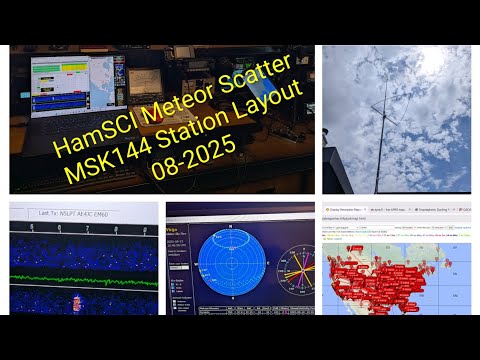
HamSCI Meteor Scatter MSK144 Station Layout and Operation — 12 minutes, recorded here at AE4JC in August 2025 for the HamSCI project. How this station is physically laid out for MSK144 and how it’s operated.
Which band, and what you’re in for
Reflected power and trail duration both fall off hard as frequency rises. The same meteor is a completely different experience depending on where you’re listening:
| Band | What a burst looks like |
|---|---|
| 10 m — 28 MHz | 3–5 seconds. The longest and most forgiving. |
| 6 m — 50 MHz | 1–2 seconds. Strongest reflections of the VHF bands, occasionally long enough to work SSB. Modest power is enough. |
| 2 m — 144 MHz | Trail duration roughly 9× shorter than 6 m. Wants 100 W or more at the feedpoint. This is the mainstream meteor-scatter band — MSK144 was designed around 144 MHz. |
| 222 MHz | Genuinely workable. Thinner, but contacts get made. |
| 70 cm — 432 MHz | Possible during a shower. Much shorter trails, much harder. |
Usable meteor scatter runs to roughly 150 MHz, though exceptionally dense trails have been known to reach as high as 500 MHz.
The trap on 2 m is polarisation, not power. Meteor scatter is horizontally polarised. The vertical already on your roof for FM and repeaters is roughly 20 dB cross-polarised — a loss no amplifier fixes. A horizontally mounted directional antenna is where this starts.
Worth being clear about the ladder: 10 m and 6 m are the easy end. 2 m is harder and busier. Starting low and moving up is the sane order, and it’s the order most people actually take.
When to point at the sky
Pre-dawn, and it isn’t folklore.
After midnight, your side of the Earth has rotated around to face the direction the planet is travelling. You’re standing on the windshield, sweeping meteoroids up. Before midnight you’re on the back glass, waiting for something to catch you from behind.
That geometry gives pre-dawn both more meteors and faster ones — and speed matters, because a faster meteoroid ionises more heavily.
Showers help; they aren’t required. Sporadic meteors arrive constantly, all year. What a shower adds is rate, and — critically for 2 m and above — denser trails. If you want to try the higher bands, a shower peak is when to do it.
The Perseids peak 12 August 2026 at 16:42 UTC.
Why the showers are named the way they are
Because it comes up, and because the answer is more interesting than it looks.
Meteoroids in a stream travel on parallel paths. Perspective makes them appear to fan out from one point — the same reason railroad tracks appear to converge. That point is the radiant, and it’s an artifact of viewing angle rather than a location.
A shower takes the name of the constellation holding that radiant, in possessive Latin, with the ending swapped for -id / -ids. Perseus → Persei → Perseids. Gemini → Geminorum → Geminids. Lyra → Lyrae → Lyrids.
Two consequences worth knowing:
- It’s Aquariids, two i’s — the genitive of Aquarius is Aquarii. The common “Aquarids” spelling is simply wrong.
- The name tells you where they appear, never where they came from. The Perseids are debris from comet 109P/Swift-Tuttle, on a 133-year orbit. Perseus just happens to be the direction we’re facing when Earth crosses the trail.
And the naming is historical, not designed. The Quadrantids are named for Quadrans Muralis, a constellation the IAU deleted in 1922 when it fixed the official list of 88. The shower had been called that since the early 1800s, so when meteor-shower names were formalised in 2009 the old one was kept. The radiant now sits in Boötes. It’s a shower named after a constellation that hasn’t existed for a century.
There’s an older layer still: the Perseids have long been called the Tears of St. Lawrence, whose feast day is 10 August, right on the shower. Chinese records of the same stream go back to AD 36 — watched and written down for nearly two thousand years before anyone knew what it was.
Tools
meteorshowers.org — interactive 3D view of meteoroid streams orbiting the Sun. Built by Ian Webster on orbits measured by NASA’s CAMS camera network and computed by Peter Jenniskens (SETI Institute / NASA Ames). The clearest way to see why the same dates come round every year.
IMO Meteor Shower Calendar — peak times in UTC, expected rates, and the minor showers nobody writes articles about.
Global Meteor Network — 450+ optical meteor cameras across 30 countries on open-source RMS software. A station is a low-light camera board, a fast lens, a housing and a Raspberry Pi. It records after sunset and analyses the night by itself before sunrise.
HamSCI — the umbrella the QSO party sits under.
Watch it happen without a station
You don’t need a radio to see this working.
- LiveMeteors.com — meteor pings streamed continuously, audible and visible, from VHF reflections. Their own caution is the best beginner’s warning on this page: a strong signal lasting more than a minute is usually Sporadic E, not a meteor.
- Meteor Live Stream, London — a 3-element Yagi aimed at the GRAVES space-surveillance radar in France, 143.048 MHz, analysed in Spectrum Lab and streamed to YouTube.
- Meteor Radio Echoes, live from Minneapolis
An open question, and it’s specifically a US problem. GRAVES makes this easy in Europe: one known, always-on transmitter to bounce off. What the best US equivalent is, this page doesn’t yet know — and guessing at it would be worse than leaving the gap visible. If you have a working answer, get in touch and it goes on the page with your call.
Other videos
Read this line before the list. These were gathered on 11 August 2026 and the content has not been reviewed — YouTube declined to serve transcripts or audio to the machine that assembled this page, so there was no honest way to summarise what’s in them. What is verified below is the title, the channel, the length and the upload date, pulled from the platform itself. Those tell you real things — who made it, how deep it goes, how old it is — and they’re offered instead of a description that would have been invented.
| Video | Source | Length | Posted |
|---|---|---|---|
| Meteor Scatter | FlexRadio Systems | 42 min | Dec 2020 |
| Meteor Scatter for Beginners, GW8JLY | R4CR Roman | 48 min | Dec 2016 |
| Meteor scatter magic: MSK144 on VHF | Amateur Radio VK3YE | 8 min | Sep 2019 |
| Meteor scatter, Geminids 2021 & Quadrantids 2022, MSK144 on 2 m | Radio Rider | 3 min | Jan 2022 |
| 6 m MSK144 QSO between K1JT and KN4NN | KN4NN videos | 2 min | Jan 2017 |
| The HamSCI Personal Space Weather Station | AMSATSA | 50 min | Aug 2026 |
Two notes that are facts rather than reviews: K1JT is Joe Taylor, who wrote WSJT-X — the software you’ll be running. And the two shortest entries are demonstrations rather than tutorials; the two longest are full-length talks.
The honest limits
- A trail is not a channel. You get a burst, not a conversation. MSK144 exists because it fits a complete exchange into 72 ms frames. The mode is built around the constraint rather than pretending it away.
- Every step up in frequency costs you both signal and time. There’s no setting that fixes this.
- Sporadic E will fool you. Long, strong, steady openings on 6 m and 10 m in a Northern Hemisphere summer are usually Es. If it lasts a minute, it wasn’t a rock.
- Patience is the actual equipment. You are waiting on something that has been in orbit for centuries to arrive during your transmit period.
Assembled from a real morning of operating — MSK144 on the Perseids, August 2026 — rather than from a textbook. Corrections welcome; the open question above especially.