You Can't Be Everywhere, So Be Ready Anywhere
October 2026
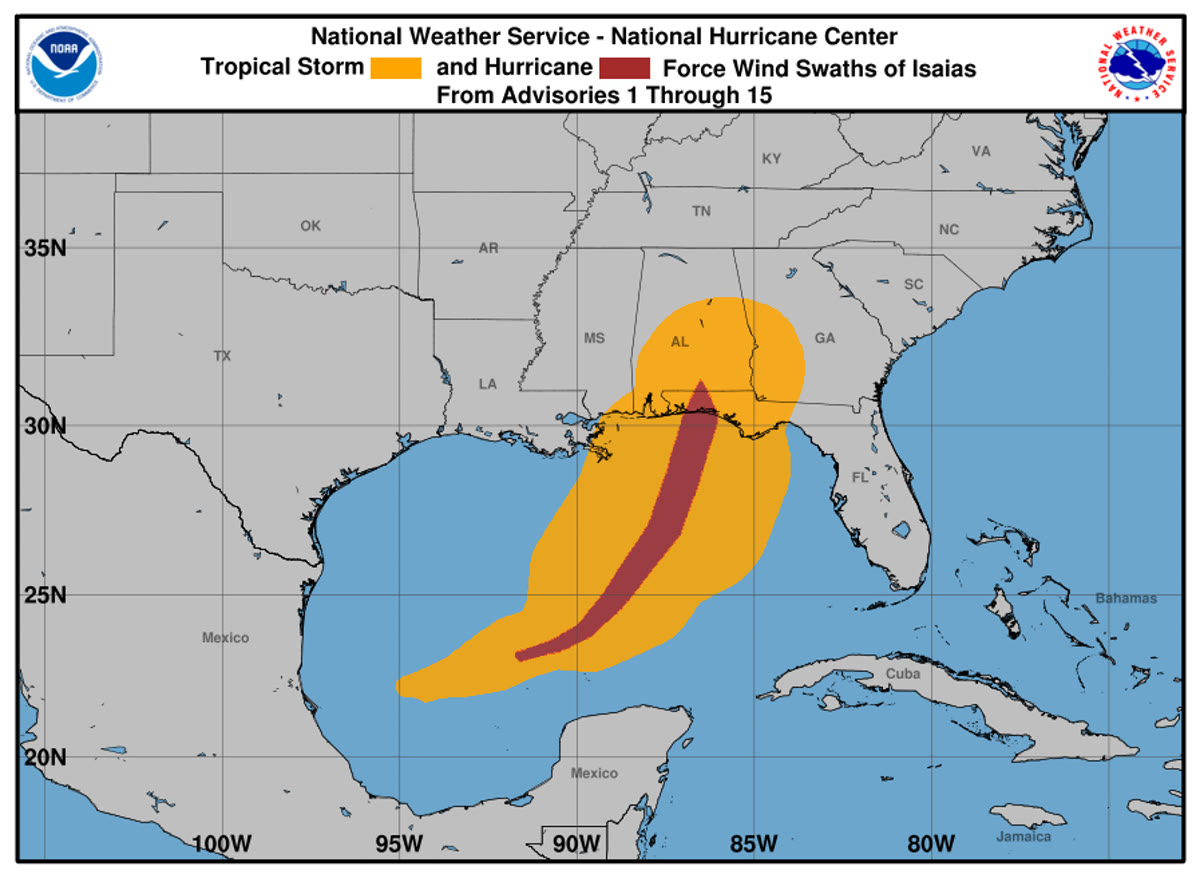 Tropical storm (orange) and hurricane-force (red) wind swaths of Hurricane Isaias (2026) across its full track, Advisories 1 through 15. NWS National Hurricane Center, public domain.
Ham Radio Emergency Preparedness: Reflections on Hurricane Isaias
Much can be learned from a dodged bullet. That’s our position this week in Baldwin County, Alabama. Forecasts had us in the crosshairs for days, but Isaias passed roughly fifty miles off our coast, outer bands only. Our neighbors in Florida bore the real brunt of it. Everything below about a near-miss describes Baldwin County’s own experience, a different one from theirs.
Milton, the seat of Santa Rosa County, took 114 mph wind gusts, widespread damage across town, and the roof torn clean off the Quikstop on Highway 90. The county absorbed some of the storm’s strongest winds as it weakened and lost organization right near landfall. The storm was blamed for eight deaths across the region: six in Florida and two in Alabama, in Birmingham and Barbour County. Hundreds of thousands of utility accounts across the Florida Panhandle lost power, and a dusk-to-dawn curfew followed in Santa Rosa County.
In the aftermath, volunteer relief efforts were quickly underway with groups like Samaritan’s Purse sending its Disaster Relief Unit 6 from Texas and God’s Pit Crew sending volunteer teams for tree and debris removal, roof tarping, and direct care.
The shape of disaster response in the United States looks like this: government mutual aid runs on request, layered from neighboring counties up through the interstate EMAC system (state-to-state, through authorized officials) for anything bigger, and established volunteer organizations work alongside that system to meet needs beyond its own resources, independent of any single county’s involvement.
We are blessed to have so many people of all capacities willing and able to help each other.
For communications, ARES (Amateur Radio Emergency Service) teams join the official response through cooperation with local authorities. In Baldwin County, the N4MZ Radio Club partnered with the County Emergency Operations Center and local shelters during the storm, coordinating directly with Natascha Torrez, the county’s Emergency Management Specialist, to assess needs and fill operator slots as the situation unfolded.
That response took shape well before landfall, through Henry (KQ4PJM), the county’s ARES Emergency Coordinator and his team of volunteers. A week out, Ken (K4EES), assistant emergency coordinator, sent the call for operators to serve at the Emergency Operations Center and at a shelter: twelve-hour shifts, an HT (handheld radio) and batteries, something to sleep on, cleared to go home once relieved. Different operators answered different shifts, depending on what each could actually commit to that week. That’s the highlight of this piece: as amateur radio operators, we can’t be everywhere, but we can be ready anywhere.
At Least Four Types Of Help
In an emergency, there are at least four different Ham Radio operating postures, each one right for a different situation. We should consider our readiness for each.
EOC (Emergency Operations Center) – embedded at the served agency’s own command post. The radio becomes the agency’s eyes and ears, relaying directly to the people making decisions.
HOC (Home Operations Center) – a station at the operator’s own house. Lower overhead, run on the operator’s own schedule, but tied to whatever that one location is facing.
MOC (Mobile Operations Center) – a vehicle-capable rig. It can reposition before or after impact, and follow where the need actually is.
POC (Portable Operations Center) – a grab-and-go kit, working wherever a body can get to, cot in a shelter included, independent of any fixed infrastructure.
During Hurricane Isaias, local operators remained flexible and ready to fill the needs as they arose. In the aftermath, that effort is worth being proud of and thankful for.
Being active throughout the year and practicing Field Days, Simulated Emergencies, and even regular POTA (Parks on the Air) deployments have helped prepare local radio operators in Baldwin County to be ready to help in whatever the situation turns out to be.
And every operation has nuance.
For example, Portable Operations Centers can appear quite different depending on the need. Carrying an HT in a pocket and running a man-portable station are both “portable,” but they’re different operations. An HT gets an operator into a repeater. A man-portable station, built from separate power, radio, and antenna modules and carried with its own food, water, and shelter, is designed to sustain itself independently in the field for days, within whatever power and resupply budget it’s built for.
Having your gear tested and ready is a must before the need shows up.
The same storm, four postures
In Baldwin County for Hurricane Isaias, Greg (N4RAI) ran the county’s Hurricane Emergency Communications desk, joined by Donna (KR4MGU), for much of the event. Chuck (WA4USA) worked a long shift at the shelter. Other members ran their stations from home: antennas and masts lowered ahead of the wind, generators tested, batteries charged, radios kept net-ready right from their own property.
Westminster Village, a Spanish Fort retirement community, built its own amateur radio response after Hurricane Sally knocked out power there for days in 2020. The club runs a central station with greater reach than any one resident’s setup, fed by residents who operate HTs and home stations from their own units. That’s the same four postures at community scale: the central station functions like an EOC for the village itself, and each resident feeding it runs HOC or POC against that local hub. During Isaias, Pattilynne (N5PLM), Ron (N4RT), and Skip (N4XXO) staffed the radios there, giving net control real-time ground truth from inside the community and standing ready to communicate on its behalf had the storm hit its original forecast track.
Greg explained something in a group chat discussion about the High Frequency Nets that were operating during the event that’s worth repeating, because it’s the real argument for where net control gets positioned: “They typically try to use net control operators who are well away from the damage path.” That’s deliberate, by his own account: net control needs to keep transmitting after the wind picks up, so his practice favors positioning the operator outside the damage path when that option exists.
And, because it was possible through a local repeater, Hurricane Helene in 2024 showed the opposite case working just as well. In the interview “Emergency Communication Lessons Learned From Hurricane Helene”, Thomas (K4SWL) talks with Dan (K2DMG), who became net control on the Mount Mitchell repeater the morning after Helene hit western North Carolina, and stayed on it for the first ten days of the response. Dan worked from inside the damage itself, on a mountain that kept power and a working repeater when almost everything else around it went dark. Both approaches were right, for what each operator could actually do from where they actually were.
Why this matters for people who aren’t hams
Most people only start thinking about radio once the things they actually rely on stop working. Cell service, home internet, and now satellite internet too. Metro Atlanta Ham Radio (K4KHOMetroATL) raised this itself last year, watching the hurricane situation in Jamaica: Starlink is a real option now for preparedness and off-grid connectivity, worth adding to a PACE plan.
A backup earns its name by staying up precisely when the primary goes down. On July 24, 2025, Starlink had a global outage that lasted about two and a half hours, caused by a software failure in its core network, unrelated to weather – proof that Starlink can fail entirely on its own. Two and a half hours can sound minor, until it’s the two and a half hours a phone, a home internet connection, and the satellite backup behind both are all down at once, each for its own separate reason.
That’s the actual case for having more than one way to communicate, and more than one posture for the people doing it. Cell towers, home internet, and satellite each fail for their own reasons, and a real storm can knock out several at once. Amateur radio, run from an EOC, a home, a vehicle, or a shelter cot, can keep working when the commercial stack doesn’t, but only on whatever repeater, power, and antenna actually survive – which is exactly why where net control sits matters.
What Carried the Weekend
The county’s own record from that weekend shows three of the four postures staffed and active – the EOC desk, the shelter shifts, and home stations across the county on written, rehearsed prep – with mobile standing by as the fourth, held in reserve for whatever comes next time.
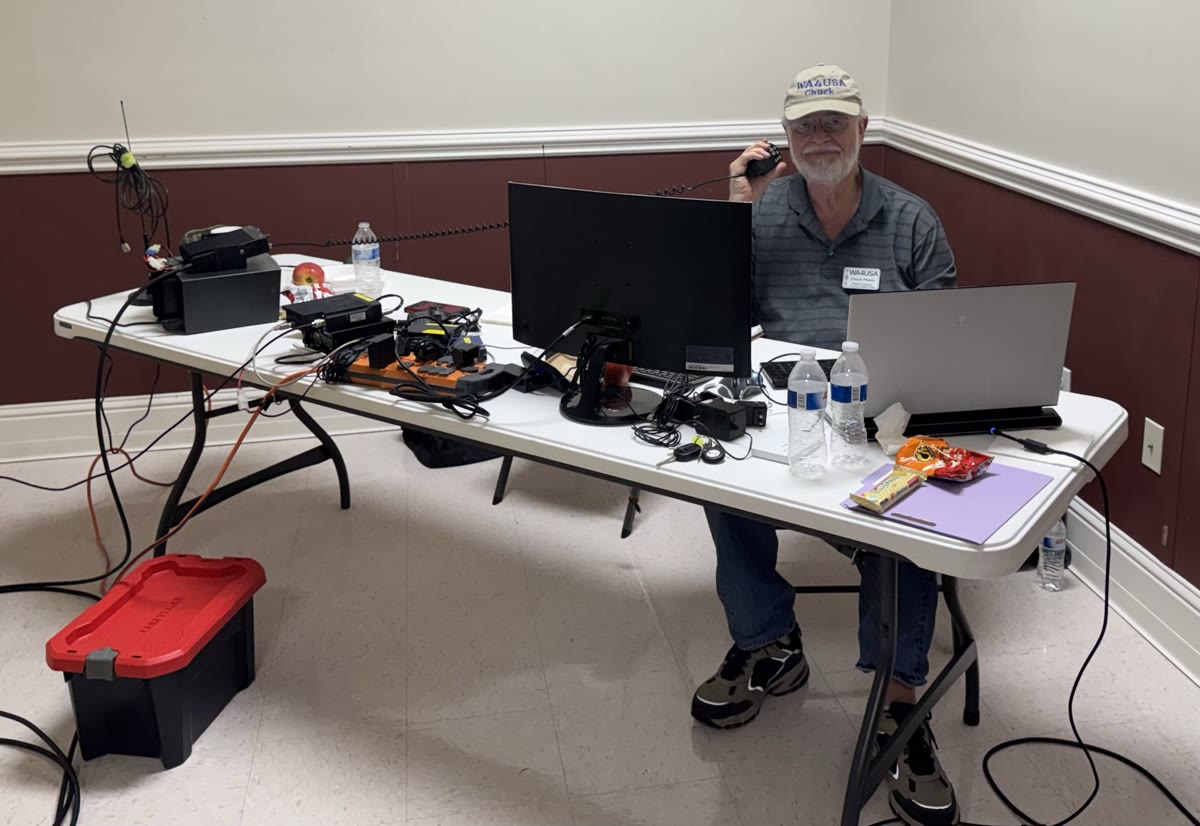 Chuck (WA4USA), partway through a 14-hour shift at the Baldwin County Coliseum shelter in Robertsdale.
The real theme underneath all four postures is a team of equipped individuals, connected to each other and to the agency they serve. Good relationships with Baldwin County’s own emergency management, and the ability to communicate clearly with them, is what turns individual readiness into real effectiveness. Thankful to be part of the N4MZ club for exactly this reason: that relationship was built over years of exercises and steady cooperation with the Baldwin County EOC, long before Isaias ever formed, and it’s what let every one of these postures plug directly into the county’s actual response.
This weekend didn’t test what matters most under real strain: whether an operator keeps answering the radio after a tree lands on their own house, whether relief arrives once a shift stretches into a second day, or whether a backup net control actually holds when the primary goes dark mid-storm. A real test looks like operators protecting their own families instead of showing up, repeaters and power failing at different times across the county, and shifts running longer than anyone planned. Isaias left every one of those questions open.
Isaias passed as a near-miss here in Baldwin County – outer bands only, local infrastructure intact throughout – so the claim here is narrower than proof under strain: three postures were filled with named staffing – the EOC seat, the shelter, and home stations kept net-ready – while mobile remained an uncommitted capability, held in reserve. Compared against Greg’s own stated practice (keep net control away from the worst of it) and against what Dan did on Mount Mitchell during Helene (operate net control from inside it, because that’s where the signal still worked), the lesson is pre-assignment rather than one universal rule: a primary net control positioned outside the forecast cone, and a backup ready on whatever infrastructure survives inside it. A storm that actually tests the system will show whether that roster holds.
Every operator has somewhere they can show up. This weekend, that was enough. The next real test will say whether it still is.