Virgo Meteor Sky View: A Ham Radio Tool for Meteor Scatter Communication
August 2025
The following screenshot shows the Virgo software (version 2.23, last updated June 25, 2024), which is a specialized tool for amateur radio operators (hams) engaged in meteor scatter communication. Meteor scatter involves bouncing VHF/UHF radio signals off the ionized trails left by meteors entering Earth’s atmosphere, enabling long-distance contacts during meteor showers when activity is high.
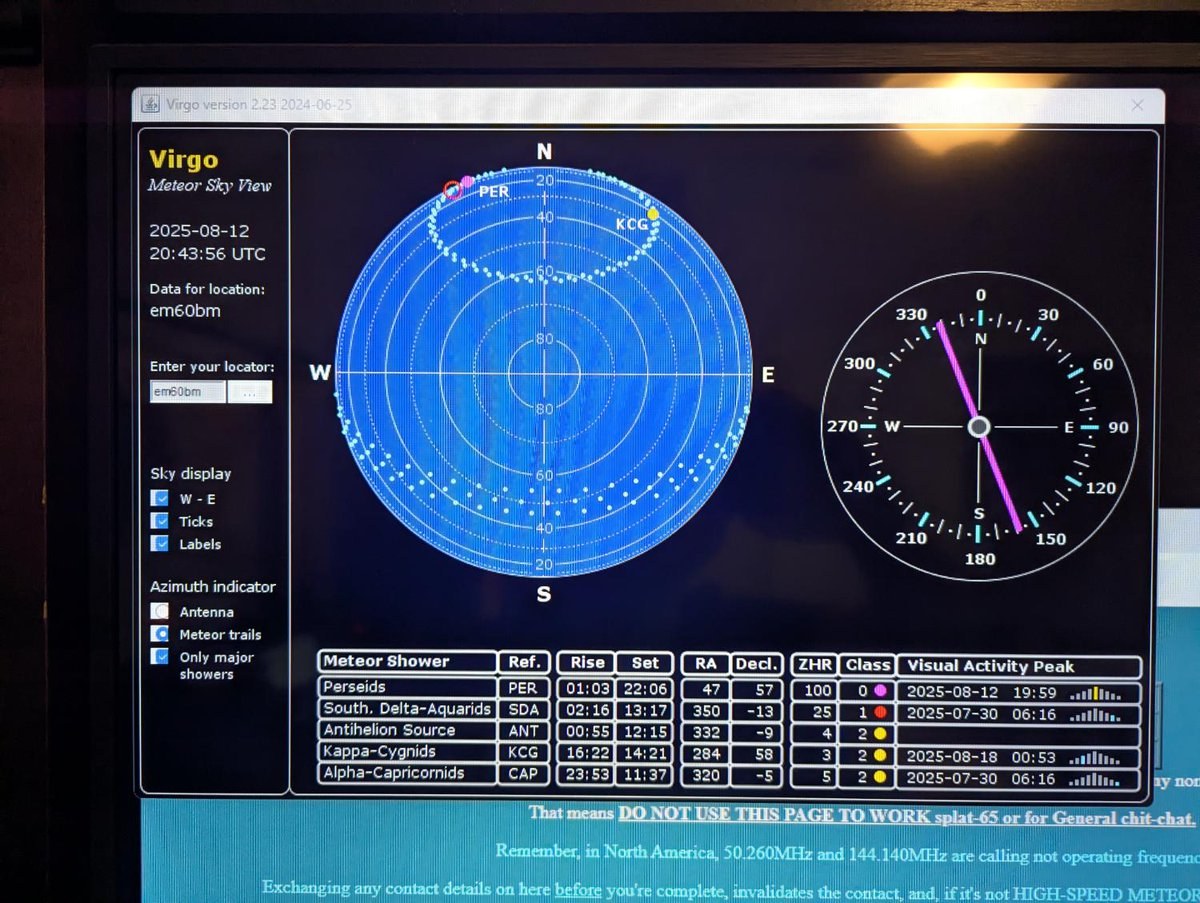
Key Elements in the Interface:
- Header and Time/Location Data:
- The app is titled “Virgo Meteor Sky View.”
- It’s displaying data for August 12, 2025, at 20:43:56 UTC (which coincides with the peak of the Perseids meteor shower).
- The location is set to “em60bm,” a Maidenhead grid locator square in Southwestern Alabama, USA (near Mobile, Alabama, or the Gulf Coast region). This is used to customize the sky view to the observer’s position.
- Sky Display (Left Circular Chart):
- This is a zenith-centered projection of the sky above the user’s location, showing altitude circles (90° at the center/zenith, decreasing to 0° at the horizon) and azimuth directions (N, E, S, W).
- Active meteor shower radiants (the apparent origin points of meteors in the sky) are plotted as colored dots with labels:
- PER (Perseids): Pink dot, high in the sky near the north-northeast.
- KCG (Kappa-Cygnids): Yellow dot, lower toward the east.
- Other showers like SDA (Southern Delta-Aquariids) and ANT (Anthelion Source) may be implied but not directly labeled on the chart in this view.
- Dotted lines likely represent meteor trails or paths.
- Checkboxes allow toggling display options like W-E (west-east) orientation, ticks, labels, azimuth indicator, antenna, meteor trails, and showing only major showers.
- Azimuth Indicator (Right Circular Chart):
- A compass-like dial showing 360° azimuth bearings (0°/360° north, 90° east, 180° south, 270° west).
- A magenta pointer is aimed at approximately 330° (north-northwest), possibly indicating the optimal antenna direction for the strongest shower (Perseids) or a calculated beam heading for communication.
- Meteor Shower Table (Bottom Section):
- Lists currently active or upcoming meteor showers with key parameters:
- Perseids (PER): Reference code PER, rises 01:03, sets 22:06, position RA 47° Dec +57°, ZHR (Zenith Hourly Rate) 100, Class 0 (major shower), peak visual activity on 2025-08-12 at 19:59 UTC. Activity graph shows a high peak.
- South. Delta-Aquarids (SDA): Rises 02:16, sets 13:17, RA 350° Dec -13°, ZHR 25, Class 1, peak 2025-07-30 at 06:16.
- Anthelion Source (ANT): Rises 00:55, sets 12:15, RA 332° Dec -9°, ZHR 4, Class 2, no specific peak listed.
- Kappa-Cygnids (KCG): Rises 16:22, sets 14:21 (possibly a wrap-around), RA 284° Dec +58°, ZHR 3, Class 2, peak 2025-08-18 at 00:53.
- Alpha-Capricornids (CAP): Rises 23:53, sets 11:37, RA 320° Dec -5°, ZHR 5, Class 2, peak 2025-07-30 at 06:16.
- Columns include rise/set times, right ascension (RA) and declination (Dec) for radiant positions, ZHR (expected meteors per hour at zenith), class (0=major, higher=minor), and a bar graph for visual activity levels.
What’s Happening Overall:
The app is actively simulating and visualizing the meteor “sky” in real-time (updated minute-by-minute using data from the International Meteor Organization) for the specified date and location. It’s focused on the Perseids shower, which is at its peak, with the radiant high overhead for optimal meteor scatter propagation. Ham radio operators use this to point antennas toward active radiants, predict ping rates, and schedule contacts during bursts of meteor activity. The interface helps in planning VHF DX (long-distance) communications by showing where to aim for the best signal reflections off meteor trails. No astronomical stars or constellations are shown—it’s purely for meteor radiants and radio purposes.
The Virgo App is currently available through this site: DL1DBC.net/Meteorscatter. 73!
Description generated by Grok, built by xAI. Photos and Edits by Matthew Foutch.
Verify you're not a bot to load comments: