Perfect Portable Power for Your QMX: PD Trigger Cable + INIU Power Bank – History and How It Works
May 2026
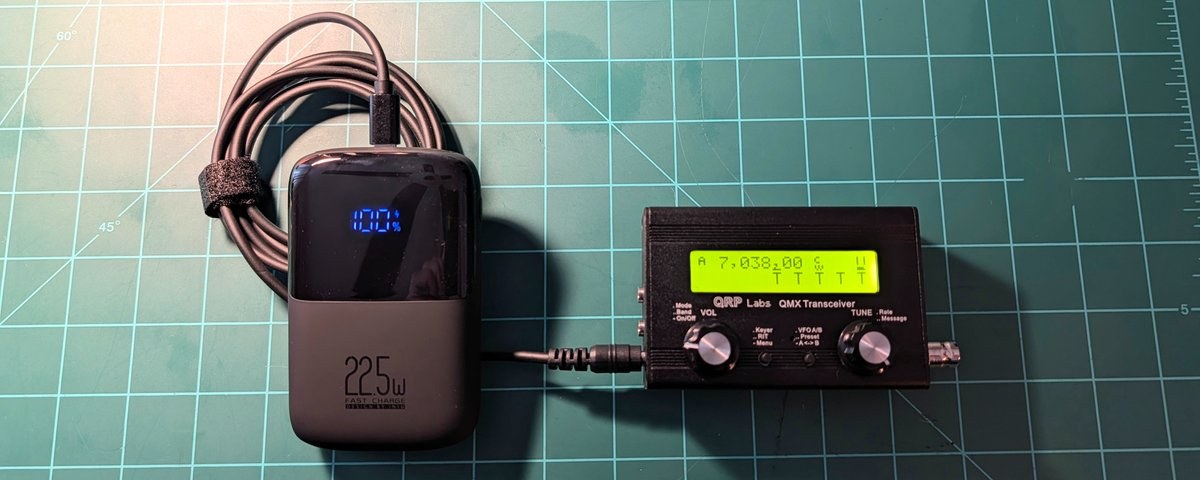
In the world of portable power for your 12-volt QMX tranceiver, few combinations are as elegant and practical as pairing a simple USB-C Power Delivery (PD) “trigger” cable with a capable modern power bank. The FASTELECTRIC USB-C to 5.5mm × 2.1mm DC barrel cable (ASIN B0CQP37NG9) and the INIU 22.5W 10,000mAh PD power bank (ASIN B09176JCKZ) create a powerful, compact system. Together they deliver clean, stable 12 V power — exactly what the QRP Labs QMX transceiver wants for reliable field operation.
A Brief History of PD Negotiation and “Decoy” Cables
USB Power Delivery was born in July 2012 with the release of USB PD 1.0 by the USB Implementers Forum (USB-IF). The standard introduced digital negotiation over the USB-C Configuration Channel (CC) pins using Biphase Mark Coding (BMC).
By 2017–2018, Chinese semiconductor companies like Injoinic Technology released affordable PD sink controller ICs (such as the IP2721). Makers quickly turned these into “PD trigger” or “decoy” cables that request a fixed voltage (commonly 12 V) and pass it straight through. The nickname “decoy” comes from the chip briefly impersonating a real PD device, negotiating, then going silent. By 2019–2020 these cables became widely popular on Amazon and in the DIY/ham community.
The FASTELECTRIC PD Trigger Cable: Minimalist Engineering
The cable acts purely as a PD sink. Its built-in chip negotiates for 12 V, then routes raw VBUS (12 V) and GND directly to the 5.5 mm × 2.1 mm barrel plug (center-positive). There is no DC-DC converter inside the cable — all voltage conversion happens in the source device.
Core component: Injoinic IP2721 (or equivalent) PD sink controller.
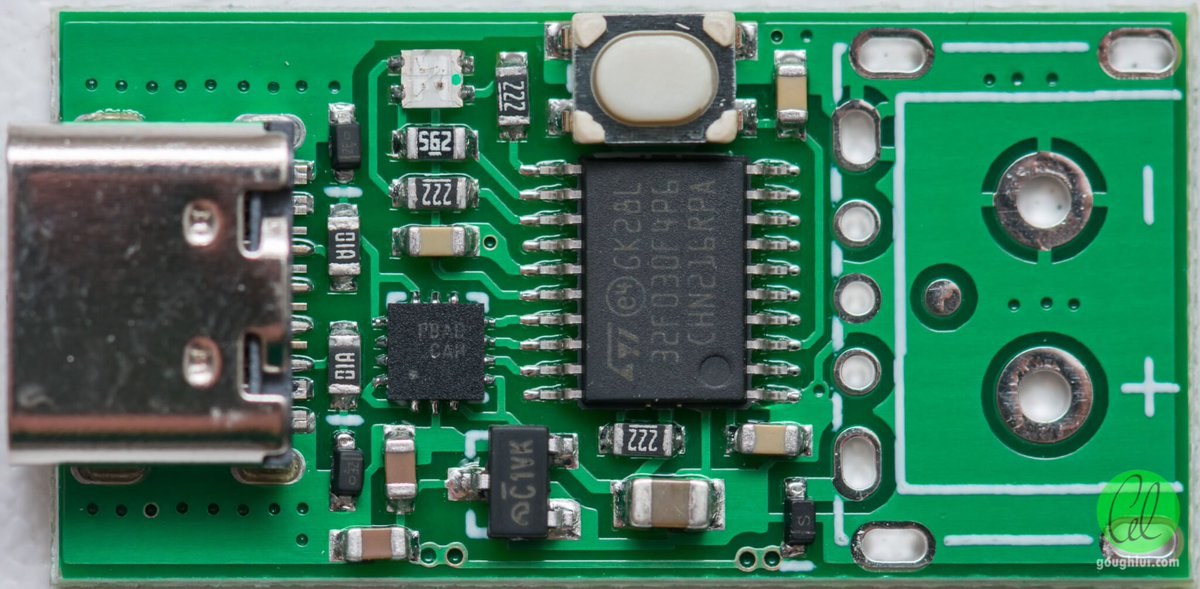
*Typical internals of an IP2721-based PD trigger board — very similar to the FASTELECTRIC cable (tiny IC + minimal passives). Source: Gough’s Tech Zone (lui_gough) – *Tested: USB-C PD Trigger/Decoy Boards
PD Negotiation Process (Step-by-Step)
- Cable plugged in → 5.1 kΩ Rd detected → Source starts at 5 V default.
- Source broadcasts Source_Capabilities (PDOs: 5 V, 9 V, 12 V, etc.).
- Trigger IC sends Request for the 12 V PDO.
- Source replies Accept, ramps to 12 V, and sends PS_RDY.
- 12 V power flows directly.
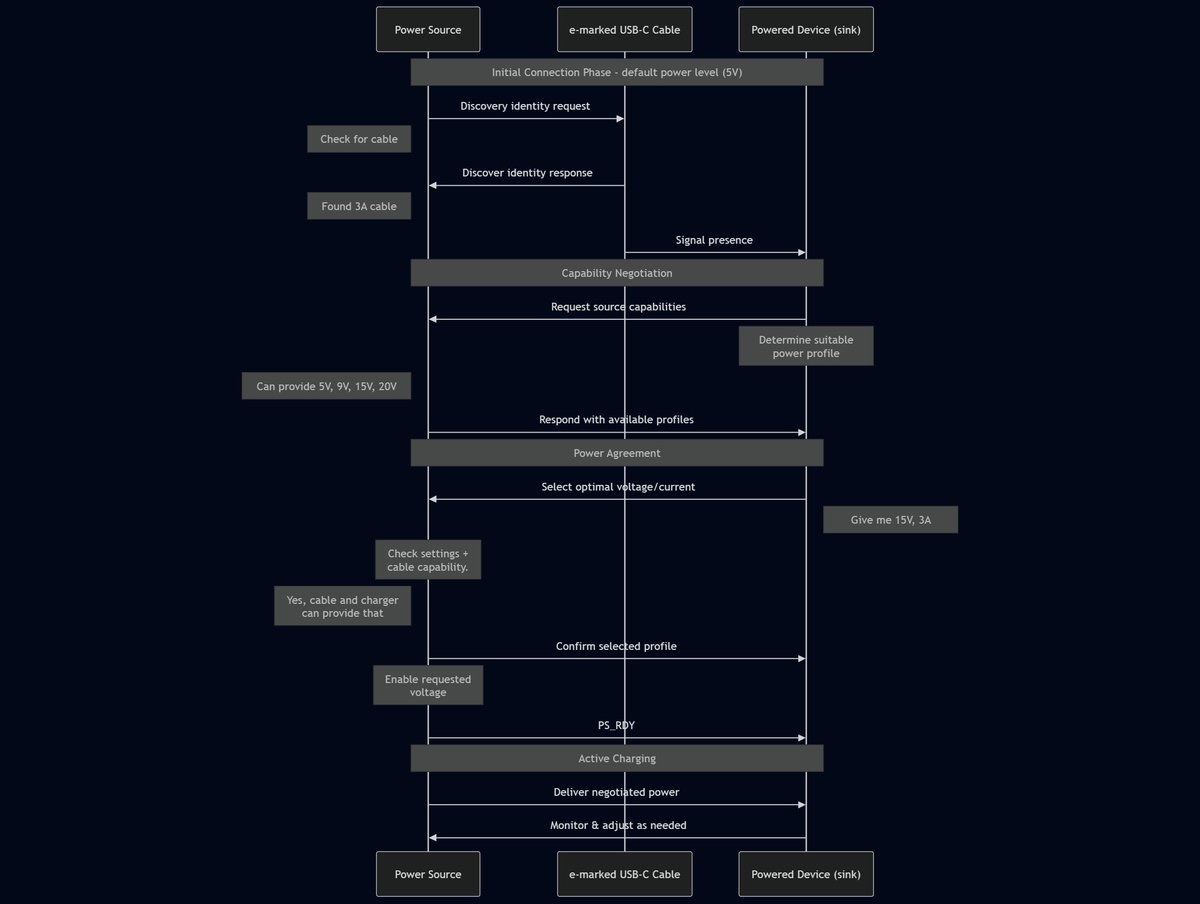
*Standard USB PD power negotiation sequence (source ↔ sink). Source: *Simplexity Product Development – USB Power Delivery Explained
Key Specs
- Output: 12 V up to 3 A (36 W max)
- Efficiency: ~99 % (no onboard losses)
- Size: Extremely compact (IC is fingernail-sized)
The INIU 22.5W Power Bank: Single-Chip Powerhouse
The INIU power bank (B09176JCKZ) uses a highly integrated Injoinic IP5356 System-on-Chip (SoC) as its sole master IC. One ~6 × 6 mm QFN chip handles everything: PD protocol, buck-boost conversion, battery management, and protections.
How it processes the trigger cable request
- Detects CC pull-down.
- Broadcasts Source Capabilities (including 12 V PDO at ~1.87 A).
- Receives Request → validates battery/thermal limits.
- Internal buck-boost ramps VBUS to 12 V → sends PS_RDY.
- Continuous monitoring for safety.
Key Specs
- Capacity: 10,000 mAh (~37 Wh)
- Max PD output: 22.5 W
- Typical 12 V output: ~1.87 A (power-budget limited)
- Efficiency: 90–94 % at 12 V
- Weight: ~100–120 g
The Perfect Partnership in Action
When you plug the FASTELECTRIC cable into the INIU’s USB-C output port:
- The cable’s IP2721 makes a polite “12 V please” request.
- The power bank’s IP5356 does all the heavy lifting (negotiation + voltage conversion).
- Clean, stable 12 V power is delivered to your QMX with excellent overall efficiency (~92 % typical) and almost no heat in the cable.
Testing note: Once your devices arrive, measure the actual output voltage and current under load with your QMX connected. Real-world results will confirm exact current limits, fallback behavior (if any), and efficiency.
QRP Labs QMX powered directly from the INIU 22.5W power bank using the FASTELECTRIC 12V PD trigger cable. The YOJOCK meter shows a stable 12.09 V with the radio powered on.
This duo is the modern, portable replacement for traditional wall-wart adapters — future-proof, cool-running, and brilliantly simple for QMX field ops.
Sources and Image Credits
- FASTELECTRIC cable: https://a.co/d/02I9iKGk
- INIU power bank: https://a.co/d/00AKJ9A5
- IP2721 trigger board photo & USB PD diagram: public technical sources (fair-use educational).
- *Gough’s Tech Zone (lui_gough) – *Tested: USB-C PD Trigger/Decoy Boards
- *Standard USB PD power negotiation sequence (source ↔ sink). Source: *Simplexity Product Development – USB Power Delivery Explained
Verify you're not a bot to load comments: